Macomb County Home Inspector
313-510-0284

Meet your home inspector!
Hello, I am Matt Fletcher of Matt Fletcher Home Inspections LLC. We have completed over 10,000 home and commercial inspections all over the Macomb County area. My father was a contractor, and I grew up working on old houses. I put myself through college rehabbing homes. I graduated with honors from Macomb Community College with an AA Degree. Then received a BA degree from The University of Detroit with honors, and master’s degree in teaching from Wayne State University. Although my master’s degree is in elementary education, I was also certified to teach high school construction trades. I have been involved in renovation, construction education, being a landlord and inspection business for over 40 years. I also own an online home inspection school globalinspectionschool.com and train new home inspectors all over the world. To schedule an inspection Call 313 510 0284 InspectDetroit313@gmail.com
We have grown over the past 40 years completing over 10,000 inspections including residential homes, commercial, industrial buildings, apartment buildings, strip malls, parking lots and parking structures, as well as City of Detroit facade inspections. We also do Property Condition Assessments (PCAs) for lenders and buyers all over the world, environmental testing such as radon, mold and lead, Phase 1 environmental site assessments for commercial mortgage lenders. I am an FHA/HUD approved inspector (FHA ID H392). We offer structural analysis by a Structural Engineer with our findings sealed by a Michigan licensed Professional Engineer (PE). Call 313 510 0284 InspectDetroit313@gmail.com

I have a fairly extensive background in renovation. This picture was taken in 1986 when I was renovating my first rental property while attending Macomb Community College. I earned an associate’s degree at Macomb and transferred to the University of Detroit, received a degree in advertising and landed a job at General Motors. I worked there seven years with great people, but I realized I wasn’t cut-out to sit at a desk, so I quit and went back to school and became a high school construction teacher.

This is my construction class at our end-of-year party, and we built the house behind us. The school district owned the land they developed a subdivision. Each year, our building trades program built a new house and then sold it. We framed the house, installed the windows, Tyvek house wrap, built stairs, insulted the house, hung drywall and helped licensed contractors with the mechanicals like, wiring the house, HVAC and plumbing.

We didn’t pour the foundation of the house but, we did pretty much everything else. Here, we are installing the underground drainage system before the basement floor is poured.
This was a new house and the drainage system worked very well. However, as homes age the drainage systems can fill with mud and tree roots and begin to fail. As they fail and don’t drain, the basements begin to leak. This is common here in the Macomb County area where we have clay soils and lots of large trees.

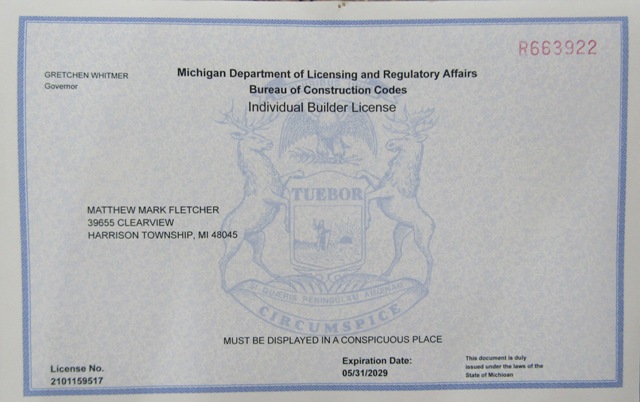
This is us framing another one of the houses we built in Roseville Michigan. l house I loved teaching but as luck would have it, the school district cut the program and laid us all off and that’s when I turned my part-time home inspection business into a full-time occupation 20 plus years ago. I now own Matt Fletcher Home Inspections LLC. I am also a licensed builder, Certified Mold Inspector & Remediator, certified in radon measurement, certified in Lead Inspection, and certified in Attic ventilation.


Before becoming a full-time home inspector, I was a state certified construction teacher, and taught construction trades to Roseville high school students where we built a real house.
Having been a real estate investor for over 25 years and have been fortunate to be featured in a few books on the subject. This book by real estate attorney, Robert J. Hill (www.RealEstateStories.com), features stories about me and my partners on pages 30, 77 and 79.

I have also been a real estate investor and “flipper” and was also featured in Deals That Make Sense by Harvard MBA, John T. Reed (www.JohnTReed.com). There is a story about a rehab project I did on page 32 called “$80,000 Rehab Profit.” I was also featured in John T. Reed’s newsletter, “Real Estate Investors Monthly” October 1999 issue. So, if you are an investor I understand your concerns when buying a property.
Be sure to visit our YouTube channel where we have over 500 helpful home inspection videos
Our Rates for single-family Macomb County home inspections are as follows:
Finished basements are added into the square footage.
0,000 Sq Ft – 1,500 = $ 425.00
1,501 Sq Ft – 2,000 = $ 450.00
2,001 Sq Ft – 3,000 = $ 500.00
3,001 Sq Ft – 4,000 = $ 550.00
4,001 Sq Ft – 5,000 = $ 600.00
5,001 Sq Ft – 6,000 = $ 700.00
We have a sewer camera and can scope your sewer line for an additional $150. Sewer scopes are $150 during the time of the inspection, $275 as a standalone inspection. Testing for radon is generally $175 to $250. Call 313 510 0284 InspectDetroit313@gmail.com
Moisture Issues
St. Clair Shores is a great community but has its share of water issues. This basement was leaking, and a contractor was there to determine how much water was behind the foundation walls. The worker is drilling a hole in the block to determine if there is water trapped inside the hallow block.

Many homes in St. Clair Shores and Harrison Twp. are on the water and built on crawlspaces. Crawlspaces should be entered and inspected if there is adequate access.
In the picture, I was able to push a screwdriver through a joist. The wood was rotten as well as having insect damage and mold. The clay soil in Macomb County doesn’t drain well resulting in more moisture in crawlspaces. Very high humidity levels in the crawlspace as well as occasional flooding can cause this type of damage.

This is a metal pole in a basement in Roseville Michigan. It had completely rusted through. The moisture in the ground wicks up into the metal poles and eventually rusts them. This is a severe case and the signs of this are usually more subtle. Moisture is typically the number one problem with homes.

When I was a high school construction teacher, we built a real house each year. In the picture, one of my students and I are installing a drainage system in one of the houses we built in Roseville Michigan.
Because Harrison Twp. is on the water, the water table in the soil is higher than other places.
There is almost always a drainage system under a house to carry water away from the basement or crawlspace. However, over time all drainage systems will eventually fail. They fill with roots, minerals and soil which plugs the system. If there is access to the drainage system either through the sump pit or clean-out caps, the system can be hydro-jetted to remove debris and restore flow.

One of the main reasons that Macomb County basements leak is the failure of the drainage system around the house. The drainage system under the floor and around the house can fill with mud and tree roots. All basements eventually leak, and a good home inspector will be looking for water marks in the basement and crawlspace. Eastpointe, Roseville and St. Clair Shores are known for leaking basements because of the clay soil. As you go farther north in Macomb County, there is more sandy soil, less clay and the basements tend not to leak as much. However, all basements eventually leak.
Warren Michigan home inspection where the foundation was bowing.

In the picture I am pulling roots out of a sump pit during a home inspection Sterling Heights Michigan. The tree roots had grown into the drain tiles around the house and all the way into the sump pit in the basement. The roots and the accumulation of mud will stop the drainage system from working.

When we inspect a building, we do a visual assessment for mold. However, mold testing is not part of a standard inspection. We have done environmental testing in homes and commercial buildings all over the Macomb County area. Mold is a natural part of the environment and EVERY building we have tested, has contained mold. Typical molds in normal amounts are generally not harmful to healthy people and are not a concern. We restrict our mold business to testing only. We do not do any sort of mold remediation, removal or clean-up. Since we only do testing, there is no conflict of interest, and we have no reason to try and scare customers into expensive clean-ups which they may not even need. Mold sampling is generally $200.00 per sample, and 2-4 samples is generally required. Outdoor Detroit area mold testing reveals that mold levels are typical to the mid-west. The mold inside your building should equal to or less than the outdoor levels.
In the photo at left I am taking a sample of the air for mold in a hundred-year-old building in the St. Clair Shores area. Ideally, the mold spore count will be in the hundreds, not in the thousands. When you can see large amounts of mold on surfaces as seen in the photo, the mold spore count will generally be in the tens or hundreds of thousands.
Macomb County Radon Testing

Testing for radon is not part of a standard home inspection but, we have the equipment and can test for radon at an additional cost. The Detroit area does have pockets of radon gas. Oakland County has much higher rates of radon that Macomb County. Radon is the number two cause of lung cancer in the United States.
In Macomb County, Michigan, the average radon levels typically range from 2 to 4 pCi/L (picocuries per liter), although levels can vary significantly from one home to another. It’s important for residents to test their homes for radon, as elevated levels can pose health risks. Testing can be done using DIY kits available at hardware stores or through professional radon mitigation services. Always follow local guidelines and recommendations for radon testing and mitigation!

Radon mitigation pumps are devices used to reduce radon gas levels in residential and commercial buildings. Radon is a naturally occurring radioactive gas that can accumulate in enclosed spaces, posing health risks, including lung cancer.
How Radon Mitigation Pumps Work:
- Suction: The pump creates a vacuum by drawing air from beneath the building’s foundation. This area, often called the sub-slab or crawl space, may trap radon gas.
- Ventilation: The collected air, along with the radon gas, is then vented outside the building, typically through an exhaust pipe that leads above the roofline. This prevents the radon from re-entering the home.
- Continuous Operation: The system operates continuously to maintain low radon levels. Most pumps are powered by electricity and have built-in alarms to notify homeowners if there are any issues.
- Combination with Other Systems: Sometimes, these pumps are part of a more comprehensive radon mitigation system, which may include sealing cracks in the foundation and improving ventilation.
Overall, installing radon mitigation pumps is an effective measure to reduce radon exposure and enhance indoor air quality.
The average cost of radon mitigation typically ranges from $1,000 to $2,500, depending on factors such as the size of the home, the type of radon mitigation system used, and regional labor costs. In some cases, more complex installations may exceed this range. It’s recommended to obtain multiple quotes from certified radon mitigation professionals to ensure an accurate estimate based on your specific needs.
Below is a sample inspection report which are typically about 40 pages in length.